Electric charges have virtual photons streaming outward as straight lines in all directions, making electric field. Electric fields begin at electron edge, which emits virtual photons. Electric-field lines indicate electric-force direction. Each line is one photon stream, so electric-field lines are not about electric-force strength or electric-field strength. Electric-field-line area density, photons per area, is electric-field strength. Because area varies directly with squared dimension, electric force decreases as distance squared: 1/r^2. Electric field has virtual kinetic energy, which can transfer to other charges at field positions to become potential energy.
moving charges
Maximum charge velocity is typically one-tenth light speed. For constant-velocity charge, electric field moves at same speed and direction as charge. Virtual photons stream outward as straight lines in all directions.
Constant-velocity fields have no transverse or longitudinal field changes, and so no waves.
moving charges: magnetic force
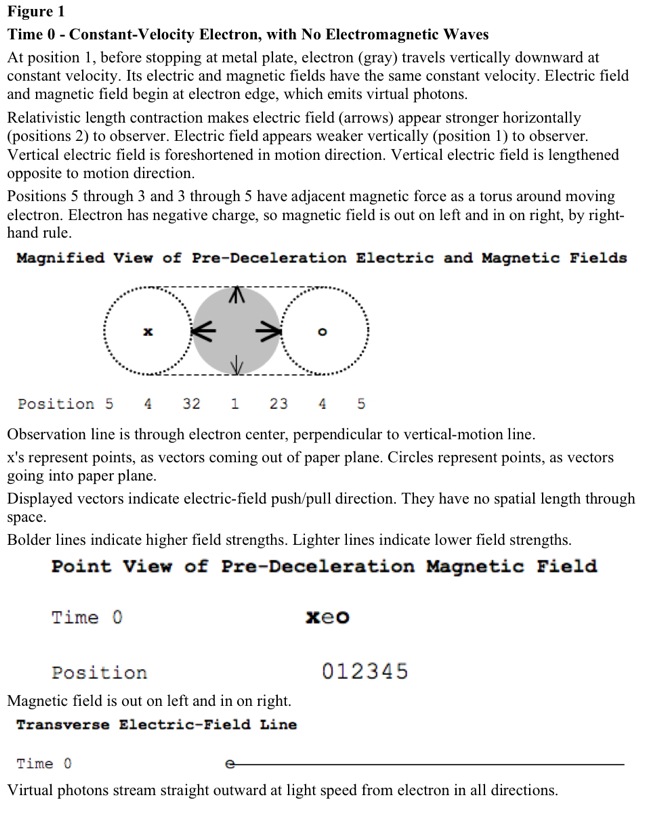
According to special relativity, constant-velocity charge causes observer transverse to charge-motion-direction to see length contraction and so increased charge-motion-direction charge density. Length contraction makes flattened-spheroid charge shape, with short axis in motion direction and long axes in transverse-direction plane. Because total charge is same for moving and stationary charge, total field strength stays the same. Relativistically increased charge density along vertical direction causes increased electric force along horizontal direction. Therefore, relativistic length contraction makes electric field appear to observer stronger horizontally. According to special relativity, observer in front or back of constant-velocity charge does not see length contraction, only that charge approaching or receding. Total electric field strength is same as for stationary electron, because total charge is same. Because total charge is same as before, charge density must be less as observed from vertical direction, so electric field appears to observer weaker vertically. Vertical electric field is foreshortened in motion direction, because electron catches up to virtual photons. Vertical electric field is lengthened opposite to motion direction, because electron moves away from virtual photons.
Electric force due to relativistic length contraction and charge-density change, and not due to total charge, is magnetic force. (Stationary charges have no relativistic motion and so no relativistic electric force.) Adjacent magnetic force is a torus around moving charge. Just as electric forces act only on electric forces, magnetic forces act only on magnetic forces, because magnetic is perpendicular to electric and so does not affect electric.
Electric force has electric field. Electric force and electric field have same direction and relative strength. Because magnetic force is relativistic electric force, magnetic force has magnetic field. Magnetic force and magnetic field have same relative strength but perpendicular direction, because force is due to transverse relativistic length contraction and so is perpendicular to motion and field. Therefore, magnetic forces have magnetic fields perpendicular to electric force/magnetic force and perpendicular to charge-motion orientation. Moving-charge magnetic field is a torus adjacent to and around charge, transverse to motion direction. See Figure 1.
For positive charge moving in right-hand thumb direction, magnetic field is in curling index-finger direction, in a circle around moving proton, and magnetic force is outward from palm (right-hand rule). For proton moving vertically downward, magnetic field is in on left and out on right. Electron has negative charge, so magnetic field is out on left and in on right.
Magnetic field has virtual photons and so has virtual kinetic energy, which can transfer to other charges at field positions to become potential energy. Stationary charge has no magnetic field, because it has no relativistic length contraction.
accelerating charge
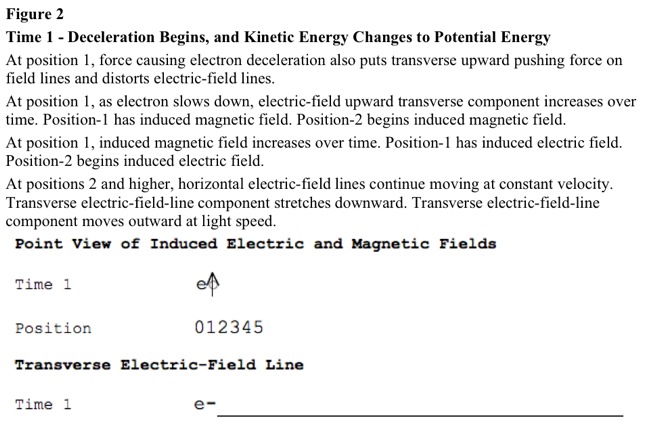
Charge acceleration pushes electric-field line transversely and stretches it sideways, causing tension and restoring force. Charge acceleration causes transverse electric field, while keeping radial field. Because virtual photons continually leave charge, transverse component moves outward along field line, so spatial transverse waves travel outward. See Figure 2.
Charge acceleration pushes magnetic-field line transversely and stretches it sideways, causing tension and restoring force. Charge acceleration causes magnetic field in charge-motion direction, transverse to magnetic field.
When stationary charge accelerates to constant velocity, electric-field lines curve toward motion direction, because charge and adjacent photon have higher velocity. When constant-velocity charge decelerates to zero velocity, electric-field lines curve away from motion direction, because charge and adjacent photon have lower velocity.
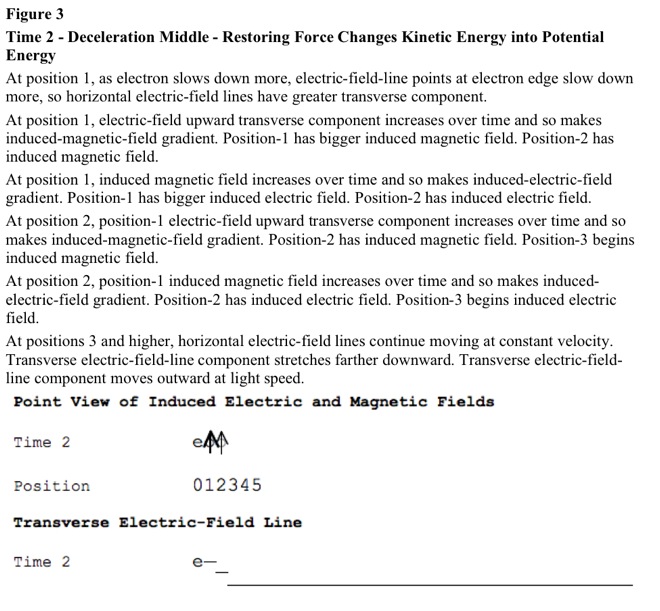
See Figure 3. Force causing electron deceleration also puts transverse upward pushing force on field lines and distorts electric-field lines. As electron slows down, electric-field-lines beginning at electron edge slow down, so horizontal electric-field lines begin to have transverse component upward.
See Figure 3. As electron slows down, electric-field upward transverse component increases over time. Changing electric-field flux (changing electric force) through an area causes relativistic length contraction transverse to area (in same plane) and magnetic-force change in toward or out from area (in same plane), and so causes induced magnetic field around area. Magnetic force has gradient in or out and so makes induced-magnetic-field gradient around. Faster change makes larger gradient.
Electric and magnetic fields interact, so they push/pull adjacent electric and magnetic fields. Interaction is strong and happens at light speed, so adjacency effect travels at light speed. Interaction is constant, so light speed is constant. All interactions are elastic, with no losses to heat or other energy, so induction has same effect later as at beginning.
Transverse effect travels inward and outward at light speed. Outward effect sees only undisturbed field line and so is the only effect and carries energy outward. Inward effect sees restoring force from stretched field line and so forces cancel and line returns to equilibrium, with no energy carried.
Electric-field increase (or decrease) causes magnetic-field increase (or decrease) that opposes electric-field increase (or decrease), by energy conservation.
See Figure 3. Induced magnetic field increases over time. Changing magnetic-field flux (perpendicularly changing magnetic force) through an area causes relativistic length contraction transverse to area (in same plane) and electric-force change around area (in same plane), and so causes induced electric field around area. Electric force has gradient in or out and so makes induced-electric-field gradient in or out. Faster change makes larger gradient.
Magnetic-field increase (or decrease) causes electric-field increase (or decrease) that opposes magnetic-field increase (or decrease), by energy conservation.
Changing electric field and magnetic field are in phase, because they both increase together and both gradients are in same direction.
Gradient and wave leading edge travels outward at constant light speed.
See Figure 3. Horizontal electric-field lines continue moving at constant velocity, because lines have same momentum, inertia, and kinetic energy as before.
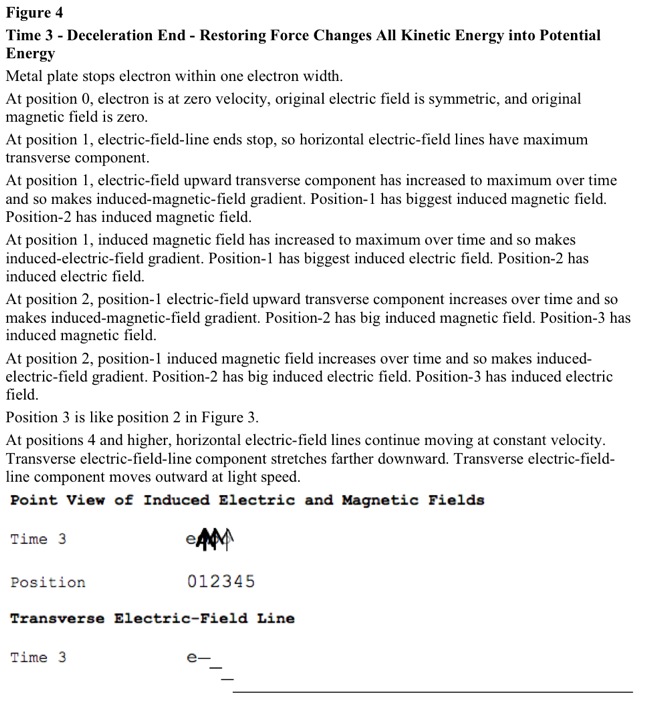
See Figure 4. As electron slows down more, electric-field-line points at electron edge slow down more, so horizontal electric-field lines have greater transverse component. Electric-field upward transverse component increases more over time and so makes bigger induced-magnetic-field gradient. Induced magnetic field increases more over time and so makes bigger induced-electric-field gradient. Transverse fields have potential energy, so horizontal electric-field lines at transverse fields have less kinetic energy. Horizontal electric-field lines continue moving at constant velocity, because lines have same momentum, inertia, and kinetic energy as before.
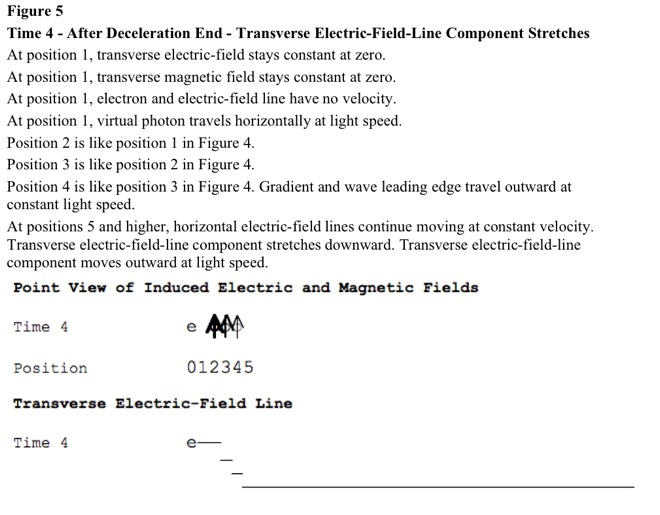
See Figure 5. Metal plate stops electron within one electron width, so distance and time are small, and deceleration is high. Electron is at zero velocity, so current is zero. Electron has no kinetic energy and momentum. Original electric field is symmetric. Original electric field has same potential energy. Original magnetic field is zero. Original magnetic field has no potential energy.
See Figure 5. As electron stops, electric-field-line ends stop, so horizontal electric-field lines have maximum transverse component. As electron stops, electric-field upward transverse component has increased to maximum over time and so makes induced-magnetic-field gradient. Induced magnetic field has increased to maximum over time and so makes induced-electric-field gradient. Induced electric field is maximum.
See Figure 5. Horizontal electric-field lines continue moving at constant velocity, because lines have momentum, inertia, and kinetic energy.
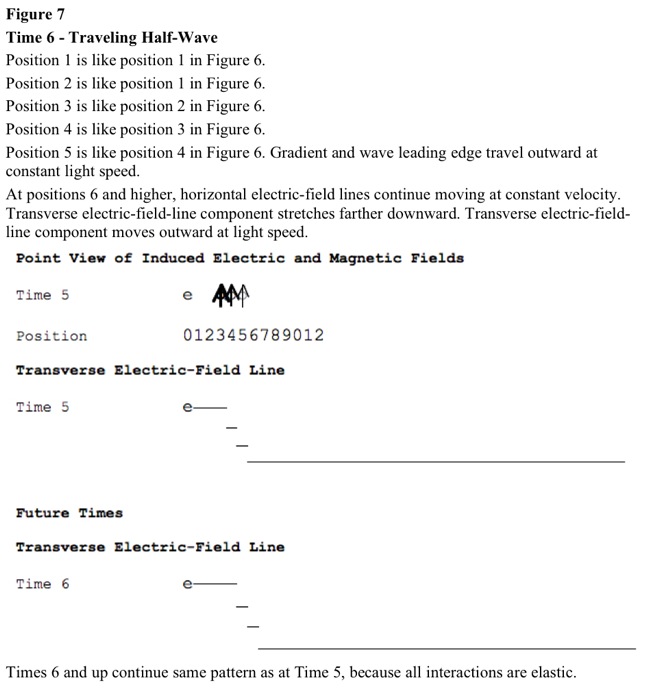
See Figure 7. Deceleration has stopped, so electron and adjacent fields stop feeling upward force. Transverse electric-field stays constant at zero, and so makes no magnetic-field gradient and no magnetic field. Magnetic-field line feels no force, so transverse magnetic field stays constant at zero, and so makes no electric-field gradient and no electric field. Electron and adjacent electric-field line have no velocity, momentum, or kinetic energy. Gradient and wave leading edge travels outward at constant light speed. Adjacent virtual photon leaves electron and travels horizontally at light speed. Transverse electric-field-line component stretches farther downward. Transverse electric-field-line component moves outward at light speed. All interactions are elastic, with no losses to heat or other energy, so gradient has same effect later as at beginning. Original virtual photons of horizontal electric-field lines continue moving at constant velocity, because lines have momentum, inertia, and kinetic energy.
phase
When stationary charge accelerates to constant velocity, electric-field and magnetic-field transverse component increase in same direction and at same time (in phase). When constant-velocity charge decelerates to zero velocity, electric-field and magnetic-field transverse component decrease in same direction and at same time (in phase).
induction
Electric-field change over time (flux) through an area makes magnetic field around area, because of relativistic length contraction. Electric current makes magnetic-field torus around current. See Figure 1.
Magnetic-field change over time (flux) through an area makes electric field around area, because of relativistic length contraction. Magnetic-field flux change through torus cross-section makes electric field around torus cross-section. Current goes through torus hole, around, and back again to complete the circuit (displacement current). See Figure 1.
Stationary electric field has constant force, and so uses no energy to make magnetic field. Moving electric field changes over time and makes constant magnetic-field gradient, because electric-field-movement kinetic energy increases magnetic-field potential-energy over space. Accelerating electric field makes increasing magnetic-field gradient, because electric-field force increases magnetic-field acceleration over space. Accelerating magnetic or electric fields over space have force that causes increasing electric or magnetic fields over time. Fields over space have potential energy, and fields over time have kinetic energy, so energy alternates between kinetic and potential, making waves.
Constant stationary magnetic field has no affect, because it has no force, so magnetic-field energy remains potential energy. Moving magnetic field changes over time and makes constant electric-field gradient, because magnetic-field-movement kinetic energy increases electric-field potential-energy over space. Accelerating magnetic field makes increasing electric-field gradient, because magnetic-field force increases electric-field acceleration over space.
induction: energy conservation
Increasing (or decreasing) magnetic field increases (or decreases) electric field, which makes magnetic field that opposes original magnetic field, by energy conservation. Decreasing (or increasing) electric field decreases (or increases) magnetic field, which makes electric field that opposes original electric field, by energy conservation.
For downward current, acceleration increases magnetic field, and that makes upward electric field, which decreases magnetic field. For downward current, deceleration decreases magnetic field, and that makes downward electric field, which increases magnetic field.
Charge deceleration is against restoring force and builds potential energy. When deceleration stops, restoring force pulls back toward equilibrium, but potential energy transfers to kinetic energy and carries past equilibrium until restoring force pulls back to equilibrium.
Energy goes into adjacent electric-field transverse movement, as interchange between electric and magnetic fields makes wave travel outward. Therefore, energy dies down at past points.
Magnetic-field and electric-field changes have same displacement amount, but electric field has approximately one hundred times more energy. Most light-wave energy is in electric field, not magnetic field, because magnetism is relativistic effect.
To make electric field, virtual photons stream outward at light speed from electron in all directions. Electric-field lines are virtual photon streams. At electron constant velocity, photons also have same velocity as electron, so electric-field lines are straight.
The figure shows virtual photons streaming outward horizontally from electron transverse to electron motion direction. Electron and electric-field lines move downward at same velocity.
Because electric-field and magnetic field interact along line, line has tension, just as a taut string has tension, so line has restoring force if accelerated sideways, just like a taut string has restoring force. All interactions are elastic, with no heat losses, so forces and energies are the same all along electric-field lines from beginning to infinity.
Deceleration can knock field lines through space. Stronger deceleration makes farther and stronger fields.
gradient
Field induction around area circumference makes space gradients as tangents to circumferences. When electric-field flux change through area makes magnetic field around area, magnetic field has gradient around area. When magnetic-field flux change through area makes electric field around area, electric field has gradient around area.
speed
Because electric force is strong, electric and magnetic fields interact at light speed. Because magnetic field and electric field couple {electromagnetic wave induction}|, transverse field-line component moves outward along electric-field line at light speed. Electromagnetic interaction strength is constant, so light speed is constant.
wave
Waves are local effects that travel. Traveling field changes are independent of original charges.
For downward current, deceleration decreases magnetic field, and that makes downward electric field, which increases magnetic field. Electric and magnetic fields are in phase. Electric-field-line disturbance moves away from charge at light speed in a straight line. Transverse component makes traveling wave half {half-wave, wave}. All disturbances to electric-field lines travel outward at light speed. Previous points have no more disturbances, so only one half-wave exists at any time. No disturbances are left behind, because all energy has traveled away. Disturbance reaches farther positions in sequence out to infinity. See Figure 1 through Figure 7. Wave exists only at induction point and can only go straight-ahead. Wave has no physical effect except at moving single point.
elastic
Electric and magnetic interactions are elastic, with no losses to heat or other energies. Therefore, disturbances travel without losing energy. Inductions continue to infinity.
strength with distance
Inductions and other electric-field-line disturbances are transverse to electric-field lines. Because electric field oscillates in a plane, not area, intensity decreases directly with distance, not with distance squared. Transverse effects happen in one dimension, so wave strength decreases directly with distance: 1/r. At later times, transverse field component stretches more over space.
electric-field-line tension and restoring force
Guitar-string molecules attract each other by electric forces. Taut guitar strings have tension from these restraining forces. Pulling string sideways puts potential energy into the string, by stretching string electric forces, like springs. After releasing string, electric forces, like springs, pull string back by restoring force. Potential energy transfers to kinetic energy. Molecule kinetic energy carries molecules past equilibrium point, so they pull on string molecules in other direction.
Adjacent to pull and release point, molecule electric forces pull-and-restore adjacent string molecules, so transverse waves travel along string. Wave speed depends on molecule electric-force strength. Wave takes energy with it, so no energy is left at original disturbance point, and it no longer oscillates. Molecule electric forces bring displacement back to equilibrium at zero.
Electric-field lines are like strings. Like guitar strings, electric-field lines have tension, because electric fields couple to adjacent magnetic fields, and magnetic fields couple to adjacent electric fields. Electric-field and magnetic-field inductions cause adjacent electric-field line points to attract, like molecule electric forces. Pushing electric-field line sideways adds potential energy. Electric-field and magnetic-field inductions make restoring force that transfers potential to kinetic energy.
Electric-field-line-point transverse disturbance displaces adjacent points, which displace their adjacent points, so disturbance travels outward along electric-field line. Electromagnetic interactions are at light speed, so wave has light speed. Wave takes energy with it, so no energy is left at original disturbance point, and it no longer oscillates. After disturbance, electric-field and magnetic-field mutual-induction restoring force brings displacement back to equilibrium at zero.
metal plate
Plate-molecule electric force decelerates electron and so decelerates electric-field line and magnetic-field line at electron edge, transverse to motion direction.
electric and magnetic forces
When electric-field-line disturbance reaches test charges far away from original charge, test charges move along charge-motion direction, because transverse electric field is voltage and electromotive force. Electric-field change and magnetic-field change reach test charge at same time. Magnetic-force effect is one-hundredth electric force. For far-away test charges, radial electric force is smaller than disturbance force, because radial force decreases with distance squared but transverse force decreases with distance. Original-charge velocity and acceleration have only negligible effect on far test charges, because waves move at light speed but charges move much slower.
Test charges along accelerating-charge direction have no transverse effects, because push or pull is in same direction as accelerated charge.
not stationary
Stationary oscillating electromagnetic fields cannot exist, because electromagnetic induction requires field movement. Standing waves result from traveling-wave superposition.
medium
Light needs no medium, because electric/magnetic fields are their own medium.
situations: antenna
Alternating current accelerates many charges back and forth along one orientation (antenna), making transverse electric-field waves that expand in planes that go through acceleration direction. Electric-field lines transverse to oscillation direction have maximum transverse component. Electric-field line along oscillation direction has no transverse components. Electric-field lines between transverse and oscillation direction have decreasing transverse component.
Electric-field change causes magnetic-field change one quarter cycle later, by relativistic length contraction, and magnetic-field change causes electric-field change one quarter cycle later, by relativistic length contraction, so phases lag each other by 90 degrees. If magnetic-field gradient first increases to north, then electric-field gradient increases to east, then magnetic-field gradient increases to south, then electric-field gradient increases to west, and then magnetic-field gradient increases to north, and so on, because each drives the other along by transverse electric force. Inductions are at right angles, rotating around direction of motion by 90 degrees. 90-degree rotations result in linearly polarized waves.
Source charge accelerations affect electric and magnetic fields at same time, so changing electric field makes magnetic field and changing magnetic field makes electric field simultaneously, so electric field and magnetic field are always in phase.
As electric field increases, magnetic field increases, because magnetic fields are relativistic effects of electric fields. As electric field decreases, magnetic field decreases. When electric field maximizes, becomes zero, or maximizes in opposite direction, magnetic field maximizes, becomes zero, or maximizes in opposite direction. Magnetic-field and electric-field changes increase and decrease in synchrony (phase), because both fields couple. Transverse magnetic-field and electric-field accelerations are equal, in phase, and perpendicular.
When electric field and magnetic field are zero, and potential energy is zero, electric-field change and magnetic-field change maximize in space and time. When electric field and magnetic field maximize, and potential energy maximizes, electric-field change and magnetic-field change are zero in space and time. When electric-field change is zero and electric field maximizes, voltage maximizes and current is zero. When electric-field change maximizes and electric field is zero, voltage is zero and current is zero. When magnetic-field change is zero and magnetic field maximizes, voltage is zero and current maximizes. When magnetic-field change maximizes and magnetic field is zero, voltage maximizes and current is zero.
Fields elastically exchange potential and kinetic energy and make harmonic oscillations. Photons continue at same frequency.
Starting from stationary charge, voltage accelerates charge and adds kinetic energy. Increasing magnetic field increases electric field until increasing electric field has slowed increasing magnetic field and both are maximum, with potential energy maximum. The slower changing electric field decreases magnetic field, which decreases electric field, so both fall in phase, as potential energy becomes kinetic energy. As kinetic energy becomes potential energy in the opposite direction, and then potential energy becomes kinetic energy, the half-cycle repeats in the opposite direction, to complete one cycle. Oscillating current repeats the cycle, and the cycles move outward at light speed. Oscillating current induces electromagnetic waves of same frequency.
Light waves have electric-field and magnetic-field linear polarizations, at right angles. Electric field oscillates in plane that goes through charge-motion direction. Magnetic field oscillates in plane perpendicular to charge-motion direction.
Leading edge of wave rises transversely at angle determined by frequency, which depends on deceleration amount. Higher frequencies have steeper angles. Higher frequencies have greater curvatures at maximum displacement, because higher frequency means turnaround is faster.
situations: dipoles
For dipoles, charge acceleration increases as charge separation increases.
situations: atoms
Atom and molecule electrons can accelerate or decelerate and so change orbits, absorbing or making radiation. Molecule dipoles can rotate, vibrate, or translate, and so accelerate electrons, absorbing or making radiation.
situations: devices
Free charges in electric and magnetic fields accelerate free charges, as in vacuum tubes. When moving electrons hit metal plates, they decelerate and can make x-rays.
Physical Sciences>Physics>Wave>Electromagnetic
5-Physics-Wave-Electromagnetic
Outline of Knowledge Database Home Page
Description of Outline of Knowledge Database
Date Modified: 2022.0224