In space-time, observers calculate that observed object times, lengths, distances, and masses depend on observer velocity relative to object {relativity}.
space-time
Space has three dimensions, time has one dimension, and space and time dimensions combine into unified four-dimensional space-time.
Objects and observers move through events on a path (world-line) through space-time. Because light is self-propagating and has no medium, zero-rest-mass particles move through space at light speed. By experiment, all objects move through space-time at light speed, so space dimensions and time dimension relate by light speed. Therefore, rest masses move through time at light speed.
In space-time, time dimension and space dimensions have same units. If space dimensions have time units, their time is space-dimension length divided by light speed. If time dimension has space units, its distance/length is time-dimension time times light speed.
absolute space-time
Universe has absolute space-time (and absolute reference frame). Absolute space-time has local curvature depending on mass and energy space-time positions. Absolute space-time has global curvature depending on mass and energy space-time positions, and so has an overall shape.
However, observers move at light speed through space-time and can calculate only observed-object relative-motion properties. Because they have a reference frame relative to space-time, they have no direct knowledge of space-time. Special relativity describes how observers moving with uniform velocity in relation to objects calculate object motions and properties. General relativity describes how observers moving with non-uniform velocity, due to gravitational fields and/or accelerations, in relation to objects calculate object motions and properties.
space and time
In classical physics, space vs. time graphs show object movements through space locations over time intervals. Objects can have any position and time. Space and time are separate and independent variables. Distance vectors sum.
In relativity, space-time unifies space and time coordinates. Space-time graphs show object space-time events. Object events cannot be at all space-time points, because object maximum speed is light speed. Because some events cannot have space-time separations from other events, separation vectors do not sum.
measurement
Stationary observers measure object length using rulers, which are stationary objects with standard length {unit length} {length unit}, such as one meter. Measurements count the number of unit lengths between object ends. In space-time, because all observers calculate that light always travels at light speed through space, observers count light's time of flight between the two object-end space-time events, and then multiply by light speed to find length.
Stationary observers measure object time using clocks, which are stationary objects with standard time intervals {unit time} {time unit} between clock ticks, such as one second. Clocks have frequencies, such as one cycle per second. If time-interval unit increases, frequency decreases. Measurements count the number of unit times between two events. In space-time, because all observers calculate that light always travels at light speed through space, observers count time of flight between space-time events.
accuracy
Experiments show that stationary clocks and their time units, and rulers and their length units, maintain accuracy for stationary observers after movement over time and space. Clocks at different space locations can synchronize. Rulers at different times and space locations can coincide. Therefore, observers can standardize on the same time at different space locations, and standardize on the same length at different times and space positions.
reference frame
Observers and objects have space-time coordinate systems (reference frame) centered on themselves. Observers and objects traveling with same uniform velocity share the same reference frame and are stationary with respect to each other. Reference frames can be stationary, have uniform velocity, or accelerate in relation to other reference frames.
Observers and observed objects travel through absolute space-time. If they travel at same speed and same direction (same velocity), observed object appears stationary, and observers and observed objects have the same space-time and reference frame. If they travel at different velocities, observed object appears to move at velocity difference, and observers and observed objects have different reference frames. Different reference frames have different events in their space-times and so have different lengths and times.
Because space and time unify in space-time, and different reference frames differ by uniform velocity, reference-frame coordinates can linearly transform into each other.
object speed through space-time
By experiment, all observers always observe that electromagnetic waves travel at light speed through empty space, even if light sources have different uniform velocities. Moving light sources do not add to or subtract from light's observed speed.
By experiment, all observers always see that massless particles move through empty space at light speed, even if accelerations start the particles. Accelerations do not add to or subtract from massless-particle observed speed.
By experiment and calculation, all observers always see that stationary, uniformly moving, and accelerating objects move through space-time at light speed.
Universe objects are always moving through space-time. If they have no rest mass, they travel through space at light speed and so do not travel through time, and space-time interval has zero proper time (light-like). If they have positive mass, they travel through less space and more time, so space-time interval has positive proper time (time-like). If they are relatively stationary, they travel through no space and only time. If they have negative mass, they travel through space and backward through time, so space-time interval has negative proper time (space-like).
stationary observers and objects
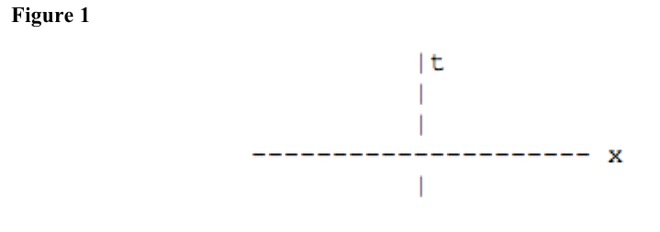
Assume that stationary-observer reference frame has a positive-upward vertical time coordinate and a positive-right horizontal uniform-motion-direction space coordinate. See Figure 1.
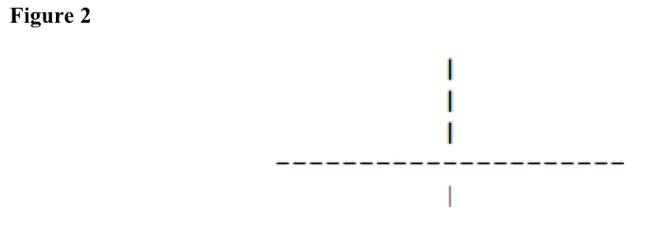
Stationary objects do not move through space, so stationary observers see stationary objects move at light speed through time only. If stationary observers start at space-time coordinate origin, their space position stays at 0, and their events move along positive time coordinate. Their world-line is perpendicular to time coordinate. After one second, they have moved one light-second vertically. See Figure 2.
uniformly moving objects
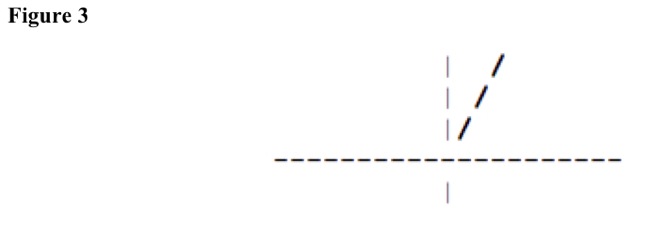
Moving objects move through space and time at light speed. To stationary observers, if a uniformly moving object starts at space-time coordinate origin, object events move along a straight line up and to the right, at angle less than 45 degrees to time axis. For example, for velocity 0.5 * c, line has constant slope of 2. See Figure 3. After one second, object has moved one-light-second in that direction.
To stationary observers, because moving object has moved through space more, and object speed through space-time is constant light speed, object has moved through time less, object time has shortened, and object time-interval unit has increased (time dilation).
massless particles
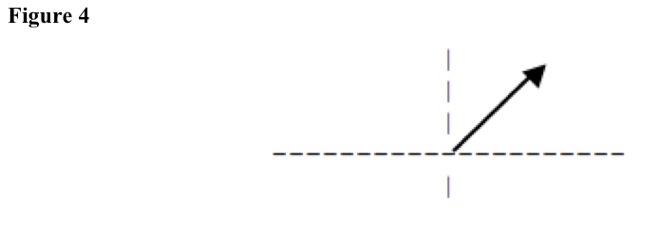
Massless particles move through space at light speed. To stationary observers, if particle starts at space-time coordinate origin, particle events move along a straight line equally up and to the right, and so at a 45-degree angle to both vertical time coordinate and horizontal uniform-motion-direction space coordinate. See Figure 4. After one second, they have moved one-light-second in that direction. To stationary observers, because moving object has moved through space maximally, and object speed through space-time is constant light speed, object has moved through time minimally, object time is zero, and object time-interval unit is infinite.
accelerating objects
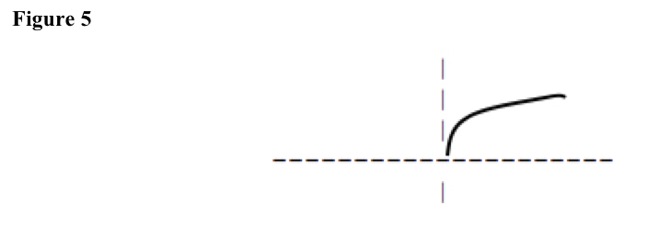
Accelerating-object velocities change. In space-time, object world-lines curve. See Figure 5.
stationary observers and moving objects, and time dilation
Stationary observers see that moving objects move through space over time. Because objects move through space-time at light speed, and relatively moving objects move through some space, stationary observers calculate that moving objects move less through time than stationary objects do. Stationary observers calculate that moving objects have shorter times. All observers see that light moves through space at light speed, and frequency times wavelength equals speed, so shorter times mean longer time-interval units (time dilation).
Because moving objects move along uniform-motion-direction space coordinate compared no movement for the stationary case, stationary observers calculate that moving objects have moved less along time dimension than stationary objects did. The number of time intervals is less, so time intervals have become longer (and clocks have slowed down).
To stationary observers, if uniformly moving objects start at space-time coordinate origin, their events move along a straight line through space-time in the positive space direction and in the positive time direction. For example, for relative velocity half light speed, straight line has constant slope 2. After one second, objects have moved one-light-second along straight line.
Because moving objects move along positive uniform-motion-direction space coordinate, stationary observers calculate that times are the same (clocks synchronize) along a different space coordinate than for stationary objects. Because light-travel distances are less, observers calculate that times are less. If clock signals come to observer from earlier in time, then they have taken longer. If clock signals come to observer from later in time, then they have taken shorter. Therefore, stationary observers calculate that moving objects receive clock signals that came from later in time. The motion-direction space coordinate has time zero at all events. To stationary observers, the motion-direction space coordinate points in the positive time direction and positive motion-direction space direction. For example, for relative velocity half light speed, uniform-motion-direction space coordinate has constant slope 0.5.
To stationary observers, moving-object reference-frame time coordinate and uniform-motion-direction space coordinate rotate toward each other the same angle. To stationary observers, massless-particle reference-frame time coordinate and uniform-motion-direction space coordinate rotate toward each other until they coincide at angle 45 degrees to both stationary reference-frame time coordinate and stationary reference-frame space coordinate.
Scientifically, time is time interval required for a photon to return to the same position in a cycle. For example, a photon leaves a source, travels to a mirror, reflects back to the source, triggers a click or photon that goes to a detector (for counting), and causes a second photon to repeat the cycle. Time measures number of unit times between time points. Time measures clock oscillations between events. Unit time can use clock frequency or period. Unit time can be oscillation number as light travels unit length.
If observers and objects are relatively stationary, the photon leaves from, and returns to, the same space position, over a time interval. The observed time and scientific time are the same.
If observers move relatively to objects, the photon leaves from, and returns to, different space positions. Because distance is longer, time interval is longer, so time is slower, and frequency is lower. Because people do not see the same path as the calculated path, scientific time is shorter.
synchronized clocks
Stationary-observer reference frame has time coordinate perpendicular to uniform-velocity-direction space coordinate. Stationary observers at an event on the time coordinate can set distant clocks to the same value as at the event (synchronization).
Observers moving at positive uniform-velocity move through positive time and space. Therefore, the time coordinate is at an angle (between 0 and 45 degrees) away from the stationary time coordinate toward the space coordinate.
Moving observers move toward stationary-observer positive-space-direction synchronized clocks. Therefore, they receive signals from those clocks earlier than stationary observer does, so they calculate that those clocks have past/earlier times. To synchronize moving-observer distant clocks with the clock at moving-observer current event, those clocks must have later times than stationary-observer clocks at the same time as moving-observer current event. Therefore, uniform-velocity-direction space coordinate is at an angle (between 0 and 45 degrees) away from stationary-observer space coordinate toward time coordinate.
Observers moving at uniform velocity have an acute angle (not a right angle) between positive time coordinate and positive uniform-velocity-direction space coordinate.
If moving observer has light speed, time and space coordinates merge at the 45-degree line. Massless particles travel only through space. All clocks have same time. Time interval becomes infinite, and time slows to zero. Lengths shorten to zero. Massless particles travel toward synchronized clocks as fast as light from clocks travels toward massless particles, but light can only travel through space at light speed, not higher.
simultaneity
Using synchronized clocks and knowing light speed, observers can calculate that events occur at the same time (simultaneity). Both events are on one reference-frame line that is parallel to time coordinate.
space-time separation
Space-time space and time coordinates use same units, either length units or time units. For time units, space distance changes to time. Because distance traveled equals light speed multiplied by time in motion, space-coordinate time is distance divided by light speed. For example, if distance is 300,000,000 meters, space coordinate has time 1 second.
For space units, time changes to space distance. Because distance traveled equals light speed multiplied by time in motion, time-coordinate distance is time multiplied by light speed. For example, if time is 1/300000000 second, time coordinate has distance 1 meter.
Two space-time points (events) have space-time separation, measured using time units or space units. Space-time separation is not spatial distance and is not time interval, but depends on both time and space coordinates. If first space-time point is at coordinate origin, and second point is (t, x, y, z), space-time separation s = (t^2 - (x/c)^2 - (y/c)^2 - (z/c)^2)^0.5, using time units.
Because unified space-time has light speed as maximum speed, space-time coordinates are not like Cartesian coordinates with time on horizontal axis, distance on vertical axis, and separation equal to (s^2 + t^2)^0.5. Cartesian coordinates are about independent space and time, which allows infinite speed through space.
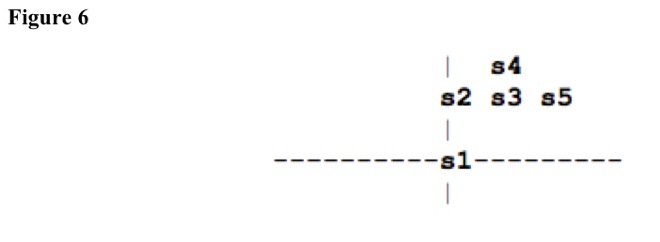
Simultaneous events have same time on time axis (no temporal separation), and so have only spatial separation. See Figure 6. s2, s3, and s5 have same time. Setting c = 1 for convenience, space-time separation between s2 and s3 is 1.
Stationary particles do not change position, so stationary-particle events have only temporal separation. See Figure 6. Setting c = 1 for convenience, space-time separation between s1 and s2 is (2^2 - 0^2)^0.5 = 2. Because motions shorten times and lengths, stationary particles have maximum space-time separation.
Moving objects have more spatial separation and less temporal separation than stationary particles. See Figure 6. Setting c = 1 for convenience, space-time separation between s1 and s4 is (3^2 - 1^2)^0.5 = 8^0.5, representing slower particles, which have greater separation. Separation between s1 and s3 is (2^2 - 1^2)^0.5 = 3^0.5, representing faster particles, which have lesser separation. Separation between s1 and s5 is (2^2 - 2^2)^0.5 = 0, representing massless particles, which have maximum speed and have no space-time separation.
Negative space-time separation means objects have moved backward in time. Because objects cannot travel faster than light, objects cannot move backward in time and so cannot have negative space-time separation.
time and separation
Space-time separation is time observed by moving object as it travels. Zero-rest-mass objects travel at light speed and feel no time change. Stationary objects feel maximum time. Massive objects travel at less than light speed and have slower time than stationary objects. Faster objects have slower time than slower objects.
time and space relation
Because space coordinates subtract from time coordinate, shortest spatial distance is longest space-time separation. Longest spatial distance is shortest space-time separation.
simultaneity is relative
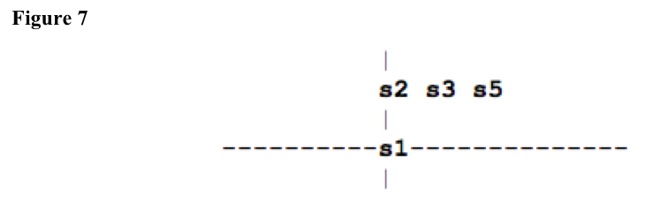
Stationary observers can synchronize different-space-position clocks to the same time. For stationary observers, if time axis is vertical, simultaneous events are on horizontal three-spatial-dimension hyperplanes. In two dimensions, if time axis is vertical, simultaneous events are on a horizontal line. See Figure 7. Events along horizontal axis are simultaneous. Events at s2, s3, and s5 are simultaneous at later time.
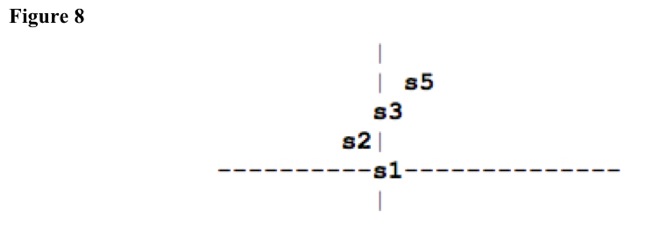
Moving observers can synchronize different-space-position clocks to the same time. If moving observers compare their synchronized clocks to stationary-observer synchronized clocks at the same spatial positions, moving observer clocks have later time in the uniform-motion direction (and earlier time in the opposite direction). Because they are moving closer to the clocks all the time, so the signals arrive quicker, for the same information to arrive at the current space position for both moving and stationary observer, the time at the distant position must be later for moving-observer synchronized clocks. For moving observers, simultaneous events are on three-spatial-dimension hyperplanes at an angle to time axis. In two dimensions, simultaneous events are on angled lines. For stationary observer, moving observer clocks are simultaneous along a positively sloped line, at a less-than-45-degree angle. See Figure 8. Stationary observer sees events s2, s3, and s5.
Simultaneous events are not simultaneous for observers with different velocities.
The three-spatial-dimension hyperplane of simultaneous events, line s2-s3-s5 in the diagram, is at same angle as world-line angle.
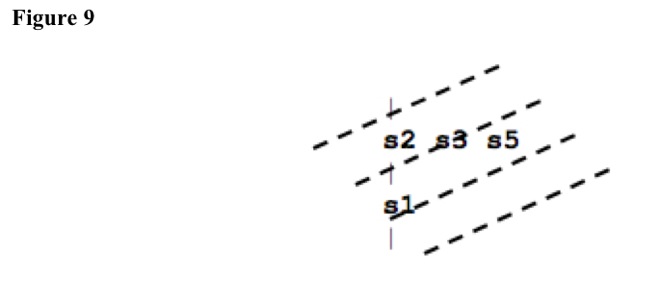
To depict moving observer at actual world-line, rather than as stationary, three-spatial-dimension hyperplanes of simultaneous events must transform their coordinate axes. Hyperplanes of simultaneous events must change from right angles to angle between world-line and space axis (limiting angle is 45 degrees). The angled-line series in the diagram represents the hyperplanes. See Figure 9.
stationary observers and moving objects, and length contraction
Because time is shorter, observers must calculate that motion-direction object distances and lengths are shorter (length contraction) so that all observers still see that light moves through space at the same light speed. Stationary observers calculate that both times and motion-direction lengths (and distances) shorten in the same proportion to keep light velocity constant. Lengths shorten in inverse proportion that time dilates.
Scientifically, length is space-time spatial distance between endpoints at space-time same time. Length measures number of unit lengths between space locations. Unit length can be a ruler. Unit length can be how far light travels in unit time.
If observers move relatively to objects, those light rays must leave the endpoints at different times, and scientific length is shorter. Moving-observer simultaneous times are later than stationary-observer ones. Coordinate transformations can calculate scientific lengths.
distances and relativity
Time shortening and length contracting are ratios. Events near each other in space and time have small total shortening. Events far from each other in space and time have large total shortening. For example, people walking and people sitting perceive several-days time difference when observing events in Andromeda galaxy. At large distances, slow relative motions can have measurable relativistic effects. At short distances, only fast relative motions show measurable relativistic effects.
observations
People and cameras observing lengths see light rays that arrive at the same time at iris or aperture. People and clocks observing time see light-ray-path-endpoint light rays that arrive at the same time at iris or detector.
If observers and objects are relatively stationary, those light rays leave the endpoints simultaneously, and observed length and scientific length are the same. Observers see and measure events whose information simultaneously reaches their space-time events. For example, stationary observers receive information from both ends of a stationary ruler perpendicular to sightline between eye and ruler-center at same time. Stationary observers simultaneously see the whole stationary ruler, but light from some positions along the ruler left before other positions. Stationary observers simultaneously see the whole night sky, but light from nearby stars left those stars a few years ago and light from farther stars left those stars longer ago.
Relativity is not about actual observer observations but about calculations based on knowledge of light speed, space-time, and space-time curvature. Length contraction and time dilation involve simultaneous points in space-time at object, not at observer. In stationary-observer reference frame, moving lengths calculate to be shorter, but human observers and instruments do not actually see or measure shorter lengths.
light
All observers see that light moves at light speed through space, no matter if light source moves relatively toward or away from observer. Light has no medium and self-propagates at light speed through empty space. Charge acceleration starts electromagnetic induction. Electric and magnetic fields change. Changing electric and magnetic fields interact to send transversely-changing electric and magnetic fields perpendicular to charge acceleration and velocity direction. Therefore, light-source motion does not supply extra motion to light speed. Light speed is the same for forward, backward, or no source motion.
Observers moving relatively to light sources along light-ray direction see frequency changes, because relative motion causes observer to encounter light-wave peaks and troughs at a different rate than if light sources are relatively stationary. If observer velocity is toward light source, expected light speed is higher than observed light speed. To reduce speed to observed light speed, length must decrease (contract). By Doppler effect, wavelength is shorter, and light frequency becomes higher. If observer velocity is away from light source, expected light speed is lower than observed light speed. To increase speed to observed light speed, length increases. By Doppler effect, wavelength is longer, and light frequency becomes lower.
Observers moving transverse to light-ray direction see light traveling at light speed, because no motion component is along light ray. If observer velocity is transverse to light-ray light source, observer sees relativistic length contraction and time dilation, in the same proportion, so relative velocity remains constant.
Relativity is about relative motion transverse to observer sightline toward object center. If massless particles, such as light photons, travel transversely, they travel only through space, do not travel through time, have infinite time interval (and clocks have stopped), and have no length in transverse direction.
To stationary observers, if massless particles start at space-time coordinate origin, their events move along a straight line at a 45-degree angle to both stationary time coordinate and stationary space coordinate. After one second, they have moved one-light-second in that space-time direction.
From a space-time event, signals can go only to space-time events in positive time direction and positive or negative space direction {light-cone}. All observed events happen in the present, unaffected by time. Only influences from previous events that have simultaneously reached space-time event can affect event. At any instant, observers see a space-time spatial cross-section.
relative distances and times
Observers with different relative velocities see the same observed objects at different events in observer space-time, so objects have different measured/calculated lengths and times. Observations are relative to velocity differences.
relativity principle and invariance
In space-time, all observable physical laws are the same at any constant velocity {principle of relativity} {relativity principle}|. At different relative velocities, observers see different length contractions and time dilations, which cancel to maintain physical laws. Only relative times, masses, and lengths have meaning for physical laws.
Because physical events occur in unified space-time, and all objects move through space-time at light speed, for stationary and moving observers, and for uniform-velocity and stationary (zero uniform velocity) systems and reference frames, physical laws are the same (invariance). Kinetics and dynamics equations, Maxwell's electromagnetism equations, and Newton's and Einstein's gravitation laws are invariant for all reference frames with uniform velocity.
By relativity, stationary observers calculate shortened lengths and times for moving objects. Because both are shorter in the same ratio, velocity is constant, and system kinetics are the same.
Such systems have no forces or accelerations. All system parts and reference-frame points have the same motion.
Calculated length contraction, time dilation, and mass increase change in the same ratio, so physical laws are the same in all reference frames differing only in uniform velocity. Space-time always has energy-momentum conservation.
no absolute velocities
Because systems with different uniform velocities have the same physical laws, uniform velocity has no physical effects, and observers cannot determine their or other object's absolute uniform velocity through space-time. All velocities are relative to observers and reference frames.
no absolute lengths and times
Because systems with different uniform velocities have the same physical laws, observers cannot determine absolute lengths and times. All lengths and times are relative to observers and reference frames.
events and physical laws
Because physical laws are invariant for all uniform-velocity reference frames and under linear coordinate transformations, physical space-time location can have no influence on physical laws, so physical laws are the same at all universe space-time points (events). There are no preferred space-time events.
event order
Before and after are relative concepts, because different observers can see different event sequences. Different observers have different pasts and futures.
Moving and stationary observers see some events in different orders. Compared to stationary observers, for events {spatially separated events} far enough apart that light cannot travel from one event to the other, moving observers see stationary events later than faster moving events.
Moving and stationary observers do not see the same spatially separated simultaneous events. Compared to stationary observers, moving observers see stationary events later than faster moving events.
relativity and space
At large distances and times, by proportionality, small relative velocities have large time-dilation and length-contraction effects. The space of relativistic velocities is hyperbolic space.
hyperbolic space
Distance equals light speed times time: x = c*t. Product of position and inverse-time always equals light speed: x * t^-1 = c. On space-time coordinates, equation graph is a hyperbola. If position is far, time is far. If position is near, time is near. If objects are rulers or clocks, distance separation and time separation are directly proportional.
mass, momentum, energy
In space-time, mass, momentum, and energy unite in a vector (energy-momentum tensor) {4-momentum}. Momentum is movement through space. Energy is movement through time. Energy equals mass times light speed squared. Action relates momentum and space and relates energy and time.
mass increase
Stationary observers calculate that relatively moving objects increase mass.
gravity and acceleration
Relative acceleration and gravity change relative velocity, so observed lengths and times depend on relative acceleration and gravity [Greene, 1999] [Mach, 1885] [Mach, 1906] [Rees, 1997] [Rees, 1999] [Rees, 2001] [Smolin, 2001] [Weyl, 1952].
electric charge
Stationary observers calculate that relatively moving charged objects increase charge density.
electric field and magnetic field
In space-time, electric field and magnetic field unite. To stationary observers, motion makes relativistic charge that has magnetic field. To moving observers, the same motion stands still, and charges have electric field. In space-time, electric field is in space, and magnetic field is in time (electromagnetic-field tensor).
geodesic
Objects travel through space-time along shortest space-time separation, which is the straightest path (geodesic) through space-time. Objects travel through positively curved space-time along shortest spatial distance and longest time. Objects travel through negatively curved space-time along shortest time and longest spatial distance.
curvature
At space-time points, mass, energy, stress, and pressure curve space-time. Around masses, gravity-field gradient (gravitational potential) is space-time curvature. Central masses curve local space-time, and that curvature pulls adjacent space-time points to curve space-time at faraway points.
Alternatively, central masses cause field energy density at far space-time points, and that energy curves space-time. Farther away space-time points have less curvature, because same energy spreads over more surface area, so energy density is less.
Energy and curvature spread to infinity at light speed, because space-time has tension and propagation characteristics the same as light-propagation speed.
free fall
Freely falling observers see no space-time curvature, because they see no acceleration, because they are at rest in the free-fall reference frame. Stationary observers at earth's surface see no space-time curvature, because they see no acceleration, because they are at rest in their reference frame.
equivalence
To stationary observers, gravity and applied force accelerate mass. Acceleration indicates space-time curvature. For both gravity and applied force, stationary observers calculate that objects move along geodesics through space-time curvature. Gravity and applied force acceleration are equivalent.
Space-time curvature is relative to observer, and so is not absolute. Observers detect only accelerations and cannot detect space-time curvature per se. However, acceleration is real and can slow clocks.
curvature and acceleration
In curved space-time, objects increasingly travel through more space, and so decreasingly less time, which means that objects accelerate. Stationary observers see increasing time dilation and time unit, decreasing frequency and time, and decreasing length.
gravitons
Gravitons are quanta of space-time gravitational waves. Because gravitons have zero rest mass, gravity acts out to infinity.
Whereas photons propagate through empty space as traveling waves in field lines, gravitons propagate through empty space as traveling waves in field surfaces. Gravitational field lines and electromagnetic field surfaces have the same tension, which is the maximum tension that they can have. Because of that maximum tension, and because they have no mass, photons and gravitons travel at light speed.
Alternatively, all zero-rest-mass bosons propagate the same because they are really the same at high energy.
tidal effects
Gravity varies inversely with distance, so objects in gravitational fields that have non-negligible diameter feel different forces on near and far sides.
However, gravity does not have to have space-time tidal effects, because local fields can be uniform, two fields can cancel, and pressure can cancel gravity, so that local space-time curvature is zero or constant.
forward time
Spatial directions can go forward or backward, but the time dimension has one direction, forward. Entropy increase, system evolution, or memory can cause time unidirectionality.
universe and relativity
Perhaps, universe is infinitely old and large, with no expansion or evolution. Perhaps, curved time coordinate allows far clocks to run slower or faster. Perhaps, far clocks stop at infinite distance, where red shift is infinite, so red shift does not need universe expansion as explanation.
electromagnetic and gravitational forces
Electromagnetism and gravity have effects to infinity and so transmit force using zero-rest-mass particles, which travel at light speed for all observers. Electromagnetic-force changes and gravitational-force changes propagate through space at light speed. Those forces' strengths determine propagation speeds, which are both light speed. Perhaps, those strengths correspond. Force strength depends on charge and mass quanta, so space-time relates to quanta. Perhaps, space-time space and time dimension relations depend on electromagnetic-force and gravitational-force strengths.
Physical Sciences>Physics>Relativity
Outline of Knowledge Database Home Page
Description of Outline of Knowledge Database
Date Modified: 2022.0224