Observers can measure relative speed and direction {relative velocity}| with respect to physical objects (and measurement reference frames), using clocks for time units, rulers for length units, and/or light signals for time and length units.
observers
Observers can measure space-time separation from current space-time event to future space-time event using light signals. Observer clocks measure time for light to go from observer to reflector and return from reflector to observer. Observer rulers measure length for light to go from observer to reflector and return from reflector to observer.
Observers and objects can be stationary or moving. Observers observe themselves as stationary and observe objects with no relative velocity as stationary, and relatively stationary things have no special-relativity effects.
Observers can move relative to objects, and objects can move relative to observers. If relative velocities are the same, the two situations are physically equivalent.
Relatively moving things have relativistic effects, which are space-time calculations about simultaneous distant space-time events. Relativity is about what must be true at distant events and so depends on calculations.
In relativity, only calculations change. Objects do not change, because observations do not affect their space-time event.
observations
People and instruments receive simultaneous signals at their current space-time event. Signals came from different points on lengths and from different phases of time. Their observations do not have time dilation or length contraction.
uniform velocity
Relative velocity measures proportion of light speed through space-time that is through space compared to that through time. Light has maximum speed through space.
Special relativity is about relative uniform velocity, with no acceleration. Special relativity is about empty space.
acceleration
Changing velocity speed or direction requires gravitational and/or electromagnetic force (including mechanical force) fields.
Zero-rest-mass particles, such as photons and gravitons, have no inertia and have no gravity, so they do not interact with other masses and gravitational energies. Adding gravitational or mechanical energy to zero-rest-mass particles does not increase or decrease their velocities. Zero-rest-mass particles travel at maximum-velocity light speed, cannot travel faster or slower than light speed, and cannot be at rest.
Zero-rest-mass and zero-charge particles, such as photons, have no inertia and have no electromagnetism, so they do not interact with other charges and electromagnetic energies. Adding electromagnetic energy to zero-rest-mass particles does not increase or decrease their velocities. Zero-rest-mass and zero-charge particles travel at maximum-velocity light speed, cannot travel faster or slower than light speed, and cannot be at rest.
direction
Two objects can move toward or away from each other (radial motion) and/or right-left and/or up-down with respect to each other (transverse motion). Special-relativity relative-measurement differences are about relative transverse motion. Motion toward or away does not change measured/calculated length or time.
observers and absolute velocity
Universe has absolute space-time. Space-time unites space and time symmetrically. Objects travel through space-time at light speed. Because light travels at light speed no matter observer or object motion, observers cannot observe absolute space-time or absolute velocity. Observers measure that moving objects have length contraction and time dilation, in the same proportion, so relative velocity stays constant, and light has constant light-sped velocity. Relative velocity does not affect physical laws, so observers cannot use experiments to find absolute velocity.
velocity, length, time
For relative velocity v, length is x * (1 - (v/c)^2)^0.5, and time interval is t / (1 - (v/c)^2)^0.5. For example, if relative velocity is half light speed, length is 0.86 * x, and time interval is 1.16 * t. If relative velocity is 99.9% light speed, length is 0.01 * x, and time interval is 99 * t. If relative velocity is light speed, length is zero, and time interval is infinite.
relative velocity maximum
If objects travel faster than light, relativistic length becomes less than zero, so physical objects cannot travel faster than light speed. If objects travel faster than light, relativistic mass becomes more than infinite.
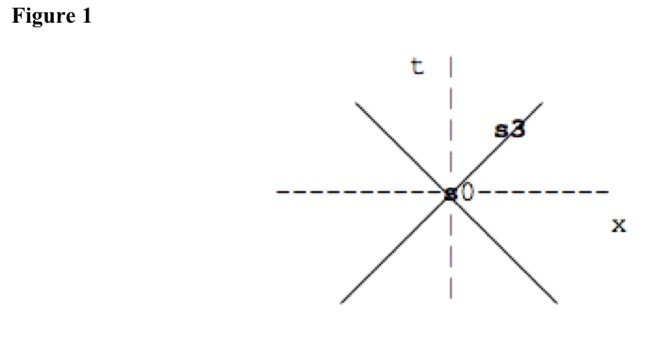
If objects travel faster than light, relativistic time interval becomes more than infinite, and time goes backward. Traveling backward in time violates causality. Space-time events can only receive signals from finite space-time event regions, whose space-time events are near enough so signals from them can reach the space-time event. See Figure 1.
faster than light
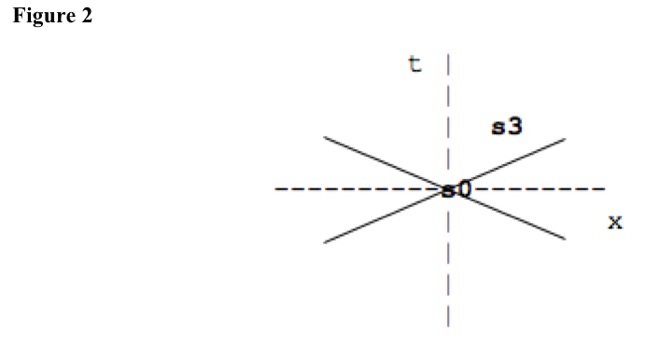
Because light always travels at light speed, faster-than-light signals from stationary objects appear to go backward in time to observer moving away. See Figure 2. If signals continue to second stationary object, toward which observer is moving, second stationary object can reflect signal back to first stationary object. Faster-than-light signals from second stationary object appear to go backward in time to observer moving toward it. The signal returns to first stationary object before it sends original signal. If signal can travel faster than light speed, observer can have event knowledge before event happens.
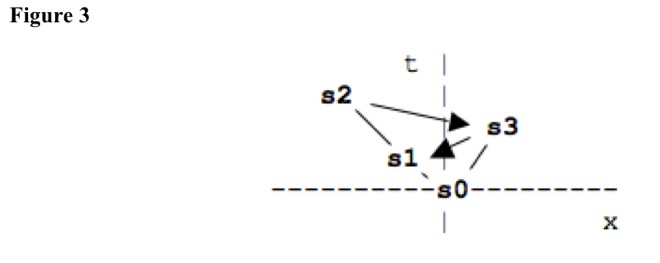
See Figure 3. Moving observers have tilted hyperplanes of space-like space-time events relative to object going from s0 to s1 to s2. They see signals from s2 as going backward in time. Moving observers have different tilted hyperplanes of space-like space-time events relative to object going from s0 to s3. They see signals from s3 as going backward in time. Object going from s0 to s1 to s2 appears to receive reflected signals from s3 at s1, before signals left s2.
Physical Sciences>Physics>Relativity
Outline of Knowledge Database Home Page
Description of Outline of Knowledge Database
Date Modified: 2022.0224