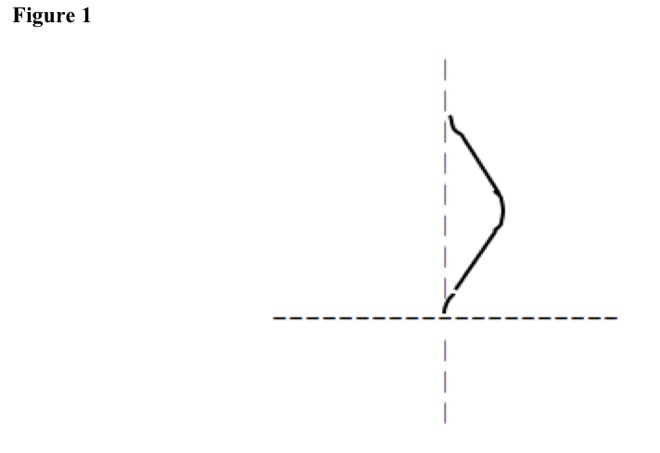
One twin stays on Earth. The other twin takes a high-speed trip, traveling to a space point and then back to Earth. Second twin must accelerate to leave Earth and travel in space, must accelerate to round point in space, and must decelerate to land on Earth. Traveling twin's clocks appear to run slower to Earth observer. Second twin is younger than first twin on return to Earth. Traveling twin ages more slowly than Earth twin {twin paradox}|.
length contraction
Traveling at almost light speed, people can cross universe in 86 years of their time, because universe lengths contract greatly. People on Earth age 13 billion years during that time.
space-time graph
Space-time graphs {Minkowski diagram} can show travel effects. The diagram assumes first twin is stationary and is observer. First twin has vertical world-line on space-time graph. Second twin has angle to right, away from Earth as twin leaves Earth, and angle to left, toward Earth as twin returns to Earth.
At beginning, twin accelerates to leave Earth and has curved world-line, with greater angles to time axis. At turning point in space, twin changes direction and has curved world-line, with lesser angles to time axis, reaches vertical, then has curved world-line, with greater angles to time axis. At landing, twin decelerates to stop on Earth and has curved world-line, with lesser angles to time axis. See Figure 1.
space-time trajectory
The shortest path is the longest time. Traveling twin has longer path and shorter time.
universe
If second twin is observer, twin on Earth travels, relative to second twin, with same motions and accelerations as described above. However, first twin does not undergo acceleration relative to universe masses, as second twin does. To second twin, universe masses have same speeds and accelerations as first twin. During acceleration relative to universe masses, time slows, because mass curves space-time. Curved space-time makes longer path and shorter time.
Permanent aging happens only during accelerations and decelerations. Uniform-velocity time dilations are symmetric between observers, are momentary, and are reversible.
Physical Sciences>Physics>Relativity>General Relativity>Time
5-Physics-Relativity-General Relativity-Time
Outline of Knowledge Database Home Page
Description of Outline of Knowledge Database
Date Modified: 2022.0224