
Relativistic electric-charge motion can caused electric force {magnetism, force}|. Magnetic fields have no net charge to stationary observers.
special relativity
Atoms and molecules have equal numbers of protons and electrons and so no net electric charge. Protons are in nuclei. Electrons orbit nuclei at 10% light speed. At that speed, motions have relativistic effects, and observers see length contraction. Stationary protons observe moving electrons, and electrons observe moving protons. Length contraction makes charges appear closer together along motion-direction line. Moving-charge density appears higher than stationary-charge density, making net electric force. Electric-charge number does not change, but relative distance decreases.
materials: iron
If electron orbits do not align, relativistic effects have all directions, and net force is zero. If electron orbits align, as in ferromagnetic materials, net force is not zero, and material has magnetism.
materials: conductors
Conductors have fixed protons and easily transferable electrons, with no net charge. Electric current moves electrons in wires at 10% light speed. Relativistic length contraction makes apparent increase in relative electric-charge density and apparent electric force. Current makes magnetism.
non-magnetic materials
People and non-magnetic materials have random molecule orientations and so no net magnetic effects.
no dipoles
Apparent electric charge in magnetism is not induced charge. Magnetism has no dipoles.
strength
At 10% light speed, relative electric-charge density increases by 1%, so magnetism is approximately one-hundredth electric-force strength. Larger currents make stronger magnetic forces. Electric generators and motors use many wires with high currents, to make strong magnetism.
direction
Electric longitudinal force between charges is along line between charge centers. Because it has no net charge, magnetic apparent-electric force cannot be along line between apparent charge centers. Magnetic transverse force is across line between apparent charges, along motion line, because apparent charge density increases only along motion line.
attraction and repulsion
Like electric force, magnetic force depends on interactions between charges. Like electric force, magnetic force can be attractive or repulsive. If apparent moving charges and stationary charges are both positive or both negative, magnetism is repulsive, because charges observe like charges. If apparent moving charges and stationary charges have opposite charge, magnetism is attractive, because charges observe unlike charges.
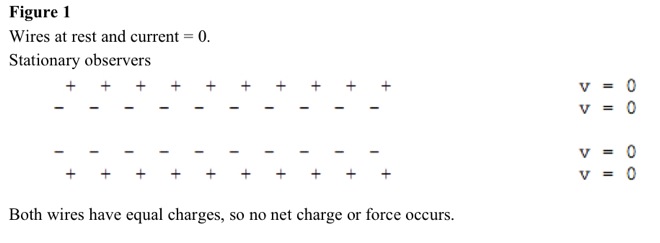
Wires at Rest with No Current
Charges are equal on both wires, and there is no movement and so no relativistic effects, so net force is zero. See Figure 1.
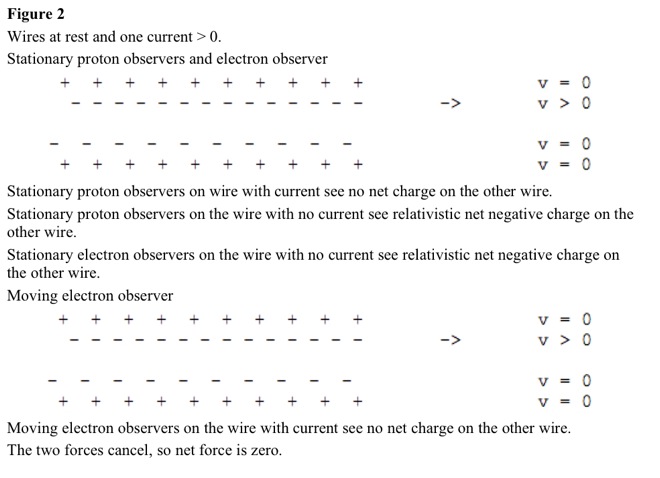
Wires at Rest and One Wire with Current
Stationary protons on wire with current see stationary protons and stationary electrons on other wire and so see no relativistic effects. Stationary protons on wire with no current see stationary protons and moving electrons on other wire and so see relativistic negative charge, making attractive force. Stationary electrons on wire with no current see stationary protons moving electrons on other wire and so see relativistic negative charge on other wire, making repulsive force. Moving electrons on wire with current see moving protons and moving electrons on other wire and so see relativistic effects, but they cancel. One force is attractive and one is negative, so net force is zero. See Figure 2.
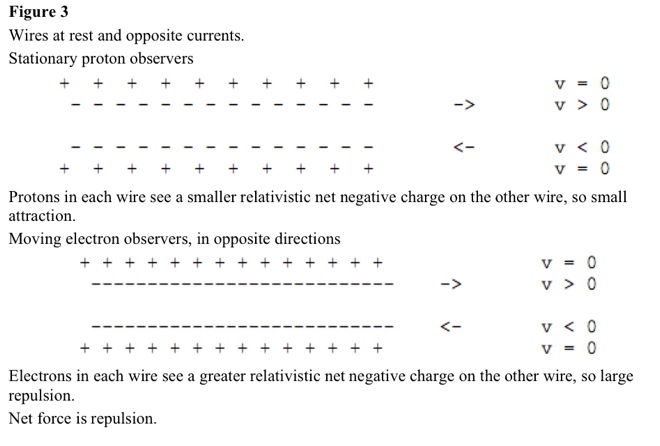
Wires at Rest and Opposite Currents
Protons in both wires see stationary protons and moving electrons in other wire and so see relativistic negative charge on other wire, making attractive force. Electrons in both wires see moving protons and moving-twice-as-fast electrons and so see net relativistic negative charge on other wire, making large repulsive force. Net force is repulsion. See Figure 3.
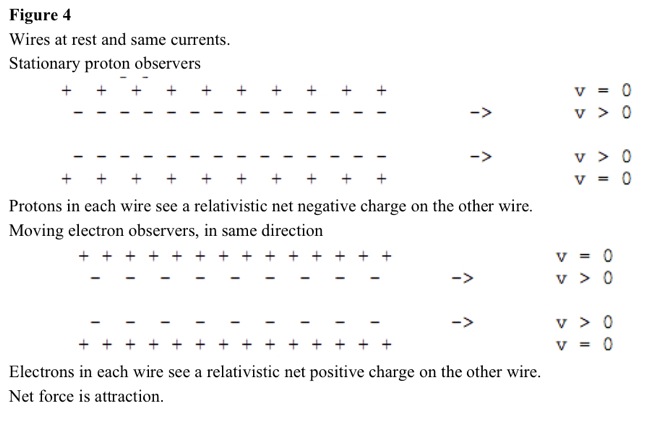
Wires at Rest and Same Currents
Protons in both wires see stationary protons and moving electrons in other wire and so see relativistic negative charge on other wire, making attractive force. Electrons in both wires see stationary electrons and moving protons in other wire and so see relativistic positive charge on other wire, making attractive force. Net force is attraction. See Figure 4.
Stationary Conductor and Stationary Test Charge
See Figure 5. Stationary conductors, with equal numbers of fixed protons and easily movable electrons, have no net charge. Electric field from protons is equal and opposite to electric field from electrons, so there is no net electric field. Conductor is not moving relative to anything, so there are no relativistic effects. Stationary single negative test charge has electric field but feels no net force from conductor, because conductor has no net charge. Test charge is not moving relative to anything, so there are no relativistic effects. Net force is zero.
Stationary Conductor and Moving Test Charge
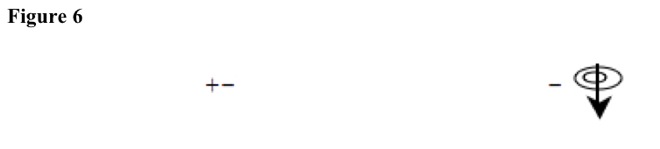
See Figure 6. Stationary conductors have no net electric field. Negative charge moves downward at constant velocity. Constantly moving charge has constant concentric magnetic field, which represents magnetic-force direction and strength that it exerts if it observes apparent charges. Test charge feels no net electric force from conductor, because conductor has no net charge. Test charge moves relative to both electrons and protons in conductor, so there is no net relativistic effect. Net force is zero.
Moving Conductor and Stationary Test Charge
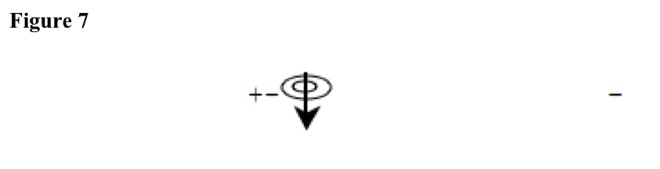
See Figure 7. Conductor moves downward at constant velocity. Electric field from protons is equal and opposite to electric field from electrons, so there is no net electric field. Magnetic field from moving protons is equal and opposite to magnetic field from moving electrons, so there is no net magnetic field. Negative charge is stationary. Test charge feels no net electric force from conductor, because conductor has no net charge. Test charge moves relative to both electrons and protons in conductor, so there is no net relativistic effect. Net force is zero.
Moving Conductor and Moving Test Charge
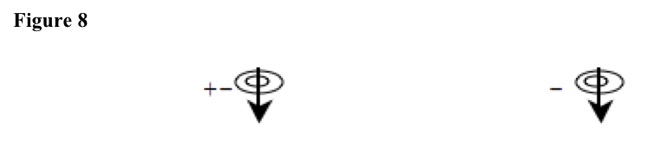
See Figure 8. Conductor moves downward at constant velocity. Net electric and magnetic fields are zero. Negative charge moves downward at constant velocity. Test charge feels no net electric force from conductor, because conductor has no net charge. Test charge is not moving relative to either electrons or protons in conductor, so there are no relativistic effects. Net force is zero.
Moving Electrons in Stationary Conductor and Stationary Test Charge
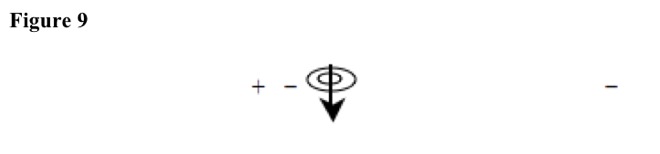
See Figure 9. Conductor electrons move downward at constant velocity. Electric field from protons is equal and opposite to electric field from electrons, so there is no net electric field. Moving electrons make magnetic field. Negative charge is stationary. Test charge feels no net electric force from conductor, because conductor has no net charge. Test charge is not moving relative to protons in conductor, so there is no relativistic effect. Test charge moves relative to electrons in conductor and sees relativistic negative charge, making repulsive force.
Moving Electrons in Stationary Conductor and Moving Test Charge
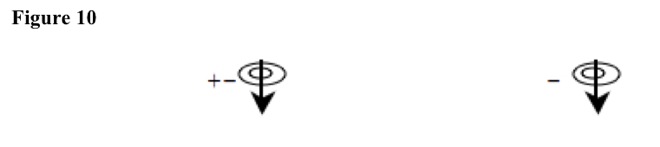
See Figure 10. Conductor electrons move downward at constant velocity. Electric field from protons is equal and opposite to electric field from electrons, so there is no net electric field. Moving electrons make magnetic field. Negative charge moves downward at constant velocity. Test charge feels no net electric force from conductor, because conductor has no net charge. Test charge is not moving relative to electrons in conductor, so there is no relativistic effect. Test charge moves relative to protons in conductor and so sees relativistic positive charge, making attractive force.
Physical Sciences>Physics>Electromagnetism>Magnetism
5-Physics-Electromagnetism-Magnetism
Outline of Knowledge Database Home Page
Description of Outline of Knowledge Database
Date Modified: 2022.0224