

Retinal output neurons {retinal ganglion cell} {ganglion cell, retina output}| generate action potentials and have axons in optic tract to brain [Enroth-Cugell and Robson, 1984] [Meister, 1996] [Niremberg et al., 2001] [Warland et al., 1997].
biology: types
Ganglion cells are magnocellular M, parvocellular P, and mixed W, which process signals separately and send separate information streams to lateral geniculate nucleus (LGN).
Retinal ganglion cells {X-cell} {beta retinal ganglion cell} can sum linearly across receptive fields. X cells have large dendritic fields. X-cells resolve finer visual patterns with higher spatial frequencies. X cells make tonic and sustained signals, with slow conduction, for detecting details and spatial orientation. More X cells are in fovea. X cell axons go to simple cells.
Magnocellular cells respond better to motion, respond better to transient stimulation, respond better to small intensity differences, are larger, have larger receptive fields, have thicker axon with faster signals, have firing rate that plateaus only at high intensity, and signal scene changes.
Retinal ganglion cells {Y-cell} {alpha retinal ganglion cell} can sum non-linearly. Y cells have small dendritic fields. Y-cells are larger and have thicker and faster conducting axons. Y cells make phasic and transient signals, with fast conduction, for stimulus size and temporal motion. More Y cells are in periphery. Y cell axons go to complex cells.
Parvocellular cells have several types, have better spatial resolution, detect color, detect higher contrast, detect more detail, are more numerous, and have more linear responses.
Both X-cells and Y-cells have ON-center and OFF-center neurons. X-cells and Y-cells have different receptive field sizes, stimulus velocity sensitivities, and spatial frequencies.
Retinal ganglion cells {W cell} can be small and direction sensitive, with slow conduction speed. W cells mix M and P cell properties and are rarest.
biology: neuron shapes
Ganglion cells {bistratified neuron} {small bistratified neuron} can have two dendrite layers. Cells {shrub neuron} can have dendrite bushes.
Ganglion cells look like auditory nerve cells, Purkinje cells, olfactory bulb cells, olfactory cortex cells, and hippocampal cells.
biology: input
Small central-retina midget ganglion cells have small dendrite clump, to collect signals from one midget bipolar cell. Midget cells respond mostly to contrast.
Parasol ganglion cells can receive from diffuse bipolar cells with bigger dendrite trees and can have dendrite umbrella, to collect signals from wide area. Parasol cells respond mostly to change.
biology: output
Ganglion cells send to LGN and then to cortical hypercolumn.
functions
Visual-receptor cells take illumination logarithm and hyperpolarize 0 mV to 4 mV from resting level 10 mV to 30 mV [Dowling, 1987] [Enroth-Cugell and Robson, 1984] [Wandell, 1995]. Retinal ganglion cells sum bipolar, horizontal, and amacrine retinal-neuron activities. Retinal ganglion cells have low spontaneous-firing rate. Ganglion cells typically respond quickly and then turn off.
Retinal ganglion cells make action potential after cyclic GMP reduces, decreasing sodium conductance through cell membrane.
functions: spots
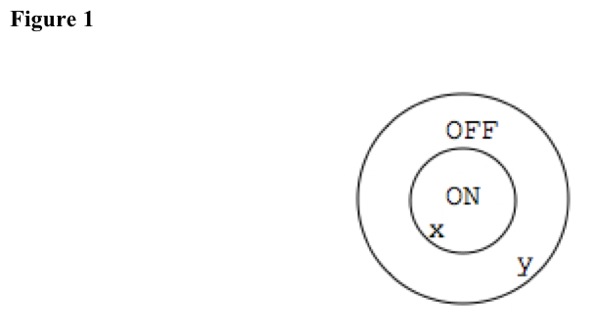
Retinal ON-center ganglion cells can respond when light intensity above background level falls on center of their receptive field. See Figure 1. Light falling on annulus surrounding receptive-field center inhibits cell.
When light smaller than center falls on center, ON-center neuron fires rapidly and then slowly. After removing light, ON-center neuron continues low firing rate. When light smaller than annulus falls on annulus, ON-center neuron does not fire. After removing light, ON-center neuron fires rapidly and then slowly.
ON-center neurons have four types, depending on excitation and inhibition. One has high firing rate at onset and zero rate at offset. One has high rate, then zero, then high, and then zero. One has high rate at onset, goes to zero, and then rises to constant level. One has high rate at onset and then goes to zero.
Other ganglion cells {OFF-center neuron} respond when light intensity below background level falls on receptive-field center. OFF-center neurons increase output when light intensity decreases in receptive-field center. Light falling on annulus around receptive-field center excites OFF-center cells.
When light smaller than center falls on center, OFF-center neuron does not fire. After removing light, OFF-center neuron fires rapidly and then slowly. When light smaller than annulus falls on annulus, OFF-center neuron fires rapidly and then slowly. After removing light, OFF-center neuron continues low firing rate.
Bipolar cells excite ON-center and OFF-center neurons. ON-center and OFF-center neurons compare light intensity falling on receptive-field center with that falling on annulus.
functions: bars
Band, bar, stripe, grating, or edge excites ON-center neuron in different ways.
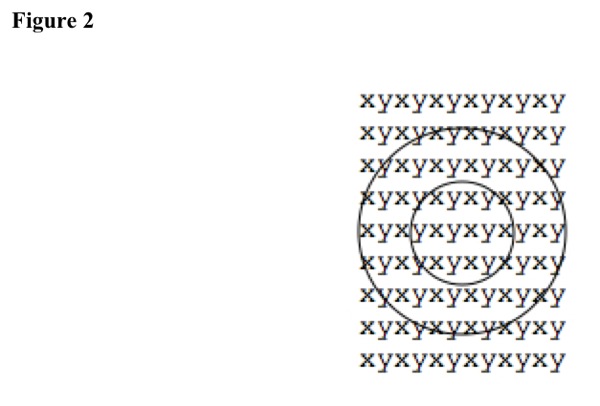
If grating has wide stripes, ON-center neuron has only spontaneous firing, because one bright band affects both center and surround, exciting and inhibiting. See Figure 2.
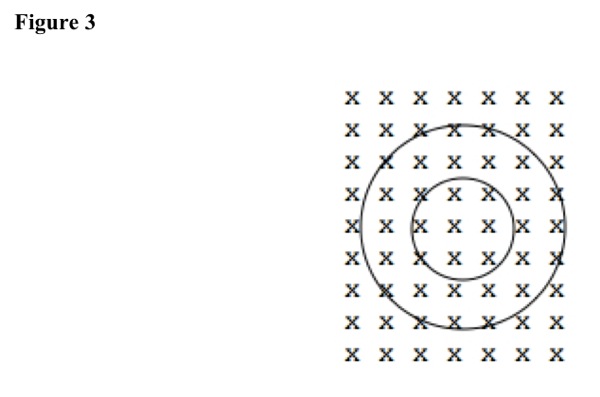
If grating has narrow stripes, ON-center neuron has only spontaneous firing, because several bright bands affect both center and surround, exciting and inhibiting. See Figure 3.
If grating-stripe width lands on center exactly, ON-center neuron fires rapidly and then slowly. See Figure 4.
For wide single long bar, ON-center neuron has only spontaneous firing, because bright band affects both center and surround. See Figure 2.
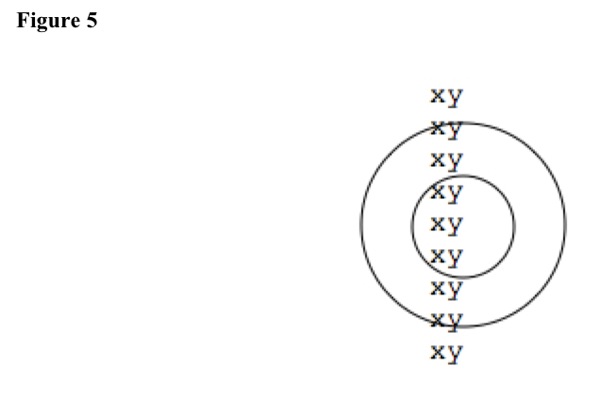
For narrow single long bar, ON-center neuron has some firing, because bright band affects mainly center but is small. See Figure 5.
If long bar lands exactly on center, ON-center neuron fires rapidly and then slowly. See Figure 4.
For long bar with end beyond center, ON-center neuron has only spontaneous firing, because bright band affects both center and surround. See Figure 5.
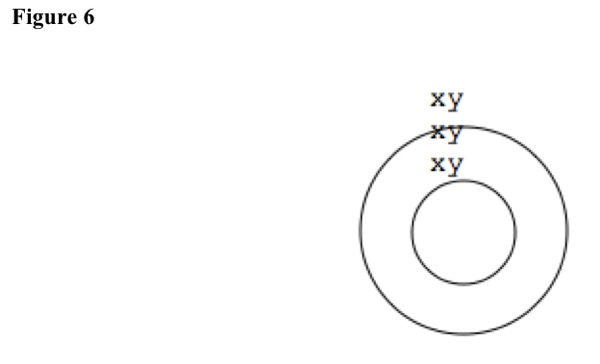
For short bar with end not yet at center, ON-center neuron has only spontaneous firing, because bright band does not reach center. See Figure 6.
For bar with end on center {end stopping, neuron}, ON-center neuron fires rapidly and then slowly. See Figure 7.
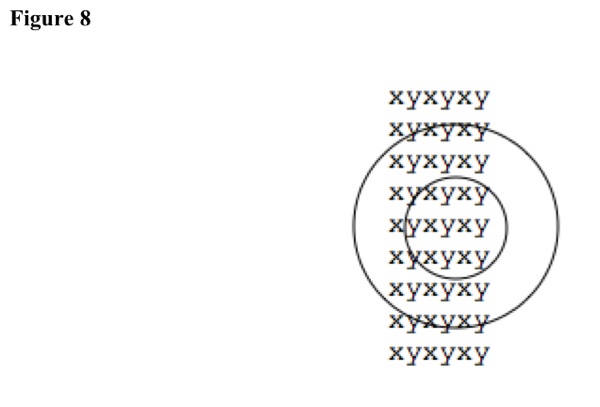
For bright edge over center, ON-center neuron fires rapidly and then slowly. See Figure 8.
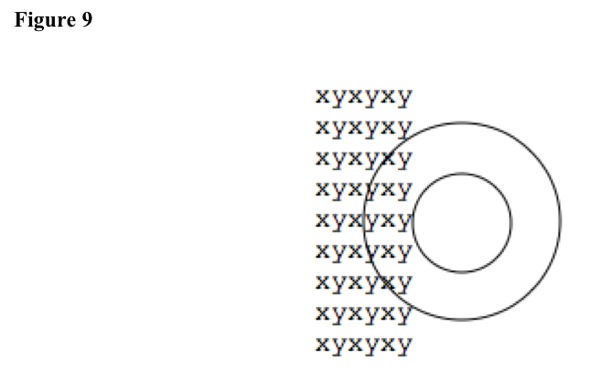
For bright edge not yet at center, ON-center neuron has no firing. See Figure 9.
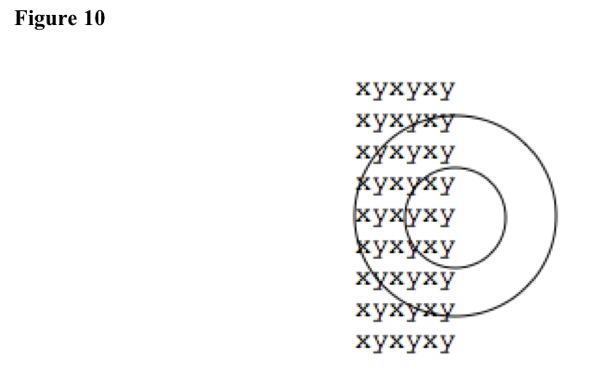
For bright edge at middle, ON-center neuron fires some. See Figure 10.
If grating-stripe width lands on center exactly, ON-center neuron fires rapidly and then slowly. See Figure 4.
If grating-stripe width shifts to half on and half off, ON-center neuron fires some. See Figure 10.
If grating-stripe width shifts to all off, ON-center neuron does not fire. See Figure 9.
For bright or dim regions, ON-center neurons have only spontaneous firing, because bright light affects both center and surround.
For bright or dim regions, OFF-center neurons have only spontaneous firing, because bright light affects both center and surround. Relative brightness depends on lateral-inhibition patterns.
functions: movement
Ganglion cells {ON-OFF-center neuron} can detect movement. ON-OFF-center neurons use time derivative of ON-center neurons to find general direction and position. Amacrine cells also excite transient ON-OFF-center neurons.
functions: color
Retinal ganglion cells can be cone-shaped cells for color detection. The three types compare light intensities in frequency range. Type is for brightness, adds green and yellow-green, and has both on-center and off-center neurons. Another type has center for one cone color and surround for another color, to compare colors. Third type, with no surround, adds green and yellow-green for excitation and subtracts blue for inhibition, to compare blue to yellow.
Biological Sciences>Zoology>Organ>Nerve>Neuron>Kinds
4-Zoology-Organ-Nerve-Neuron-Kinds
Outline of Knowledge Database Home Page
Description of Outline of Knowledge Database
Date Modified: 2022.0224