Formal mathematical system, such as arithmetic, algebra, geometry, or set theory, has true propositions that people cannot prove true or false using theory definitions, axioms, rules, and theorems {completeness theorem} {Gödel completeness theorem} {Gödel's theorem} {incompleteness theorem}. Formal mathematical system that includes all true mathematics theorems cannot exist.
formal system
Formal mathematical systems have finite numbers of word and symbol definitions, assumed-true axioms, and rules for combining words, symbols, and statements. Propositions combine words, symbols, and axioms. Typically, formal systems can form an infinite number of propositions.
For example, arithmetic is a formal mathematical system. It defines real numbers; sign symbols, such as plus and minus; operation symbols, such as addition and multiplication; grouping symbols, such as parentheses, brackets, commas, and spaces; variable symbols, such as x and y; proposition and axiom symbols, such as A and B; quantifier symbols, such as existential quantifier and universal quantifier; and logic symbols, such as AND, OR, NOT, IMPLIES, and IF. Arithmetic has axioms, such as commutation and association, about addition and multiplication operations. Arithmetic has axioms that are logic truths, such as "NOT of NOT of statement is statement", and "NOT of function existential quantifier is equivalent to universal quantifier for function NOT". Arithmetic has rules to derive propositions from previous propositions, for example, specifying variable value. Important rule is "If implication premise is true and implication is true, conclusion is true." Arithmetic can use word and symbol definitions, axioms, and rules to calculate and represent variables and functions.
proof
Formal-mathematical-system purpose is to prove propositions true or false. Proofs are proposition series that use axioms, rules, and theorems to go from premise to conclusion. Valid formal mathematical systems prove true theorems and disprove false statements. Later proofs can use proved theorems.
natural number
Natural numbers are finite digit sequences, with no signs or symbols. Natural numbers can have binary coding.
code array
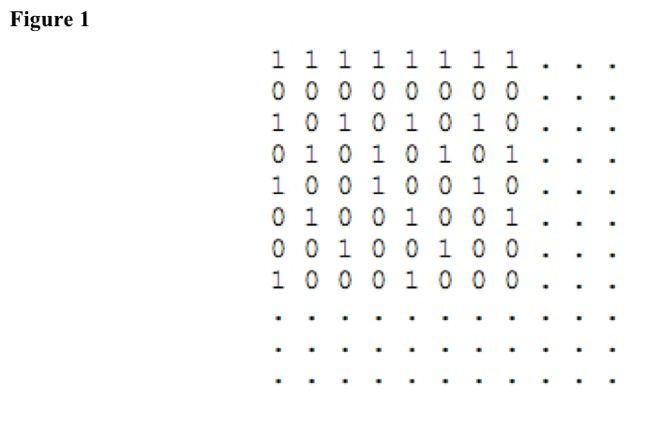
Because formal systems have finite parts and countable propositions, unique natural numbers can represent words, symbols, axioms, propositions, theorems, and rules. Proposition series can be unique natural-number series, and coded proofs are countable unique natural-number series. Listing all natural numbers represents the formal mathematical system. Number of binary digits needed to express all mathematical-system propositions and proofs is the same as number of propositions and proofs. Therefore, list length is the same as width. See Figure 1.
constructing new natural number
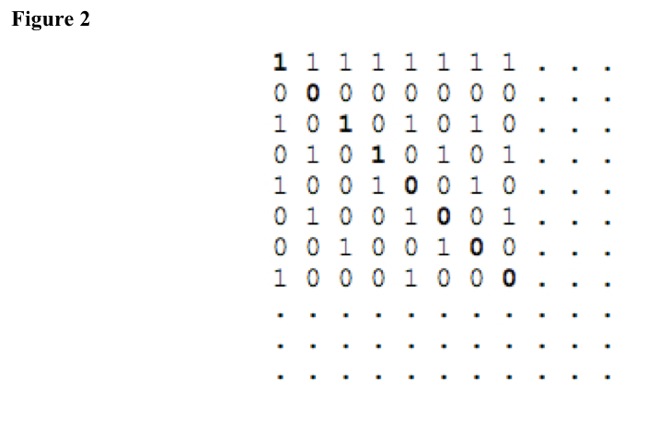
Starting from unique natural-number list, one can construct a new natural number that is not in original system by the following method. Start with diagonal {diagonal slash} of the square list. See Figure 2.
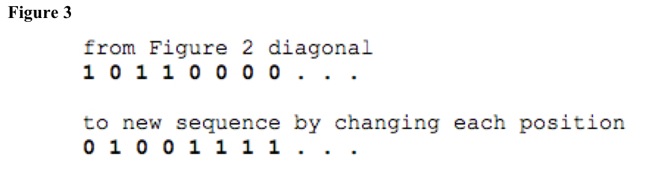
Change marks at intersections of first row and column, second row and column, and so on. See Figure 3. New digit sequence has same length as the others and is unique natural number. It is not the same as any row or column sequence. It differs from first row and column at first number, differs from second row and column at second number, and so on.
completeness
The unique natural number represents a statement that was not in original system. However, original list contained all system propositions. Therefore, no formal mathematical system can be complete. One can always derive new statements.
consistency
Original list contained all proven system propositions, so new statement has no proof yet. New proposition is derivable from system but is neither true nor false yet. System plus new statement is indeterminate and inconsistent.
incompleteness or inconsistency
If system lacks the proposition proof, proposition does not have correct form. However, proposition came directly from original propositions and so must have correct form. Therefore, statement is part of formal system but is indeterminate in trueness or falseness. Such formal systems are not consistent.
If system has the proposition proof, proposition is in current system but was not in original system. Such formal systems were incomplete.
If a formal system has only true propositions, and if the system does not prove the newly derived proposition, NOT of new proposition is false, because system already has all true-proposition proofs. New proposition is true, but its proof is not in system. Such systems are inconsistent.
If a formal system has only true propositions, and if the system does prove the newly derived proposition, new proposition is true, because all proven statements are true. However, all true propositions were already in system. Such systems were incomplete.
Formal systems must be either incomplete or inconsistent.
question
Number of binary digits needed to express all mathematical-system propositions and proofs is the same as number of propositions and proofs, so another binary digit must be added to all original propositions and to new proposition. To make a valid formal system, adding a proposition must change the original propositions. Note: Added binary digit can be the same as or different from added binary digit in original statements. Perhaps, the new system can be complete and consistent.
Mathematical Sciences>Mathematics>Axiomatic Theory>Completeness
3-Mathematics-Axiomatic Theory-Completeness
Outline of Knowledge Database Home Page
Description of Outline of Knowledge Database
Date Modified: 2022.0224