For continuous functions, range has change rate {derivative, function} {first derivative} with domain {differentiation, mathematics}. Functions f have independent-variable domain, such as time t, and dependent-variable range, such as distance x: f(t) = x. You can differentiate to find how distance x varies with time t: velocity v = df = dx / dt. For functions whose domain is time and whose range is velocity, you can differentiate to find how velocity v varies with time t: acceleration a = dv / dt.
Curve or surface functions have y-axis range and x-axis domain. At domain and range points (x,y), you can differentiate to find angle A of tangent to curve: tan(A) = dy / dx. You can also calculate slope of line normal to curve or surface.
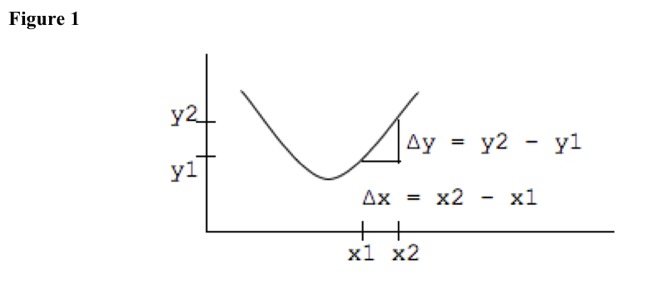
See Figure 1. For function y = f(x) and two function points (x1, y1) and (x2, y2), change rate {slope, function} between two points is (y2 - y1) / (x2 - x1). Slope converges to value {limiting value} {limit} as x2 - x1 approaches zero at point (x1, y1). Limit is change rate at point (x1, y1).
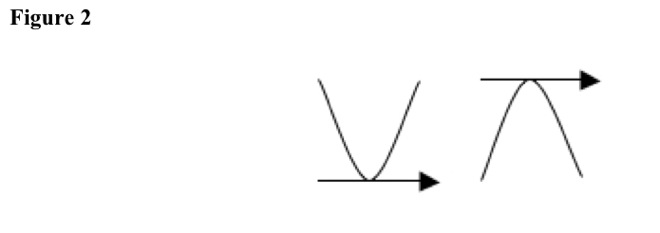
See Figure 2. Functions have maximum or minimum where tangent slope is zero, because function has reached top or bottom.
Mathematical Sciences>Calculus>Differentiation
Outline of Knowledge Database Home Page
Description of Outline of Knowledge Database
Date Modified: 2022.0224