In land-vertebrate eyes, flexible lens focuses {accommodation, vision} image by changing surface curvature using eye ciliary muscles. In fish, an inflexible lens moves backwards and forwards, as in cameras. Vision can focus image on fovea, by making thinnest contour line and highest image-edge gradient [Macphail, 1999].
process
To accommodate, lens muscles start relaxed, with no accommodation. Brain tightens lens muscles and stops at highest spatial-frequency response.
distance
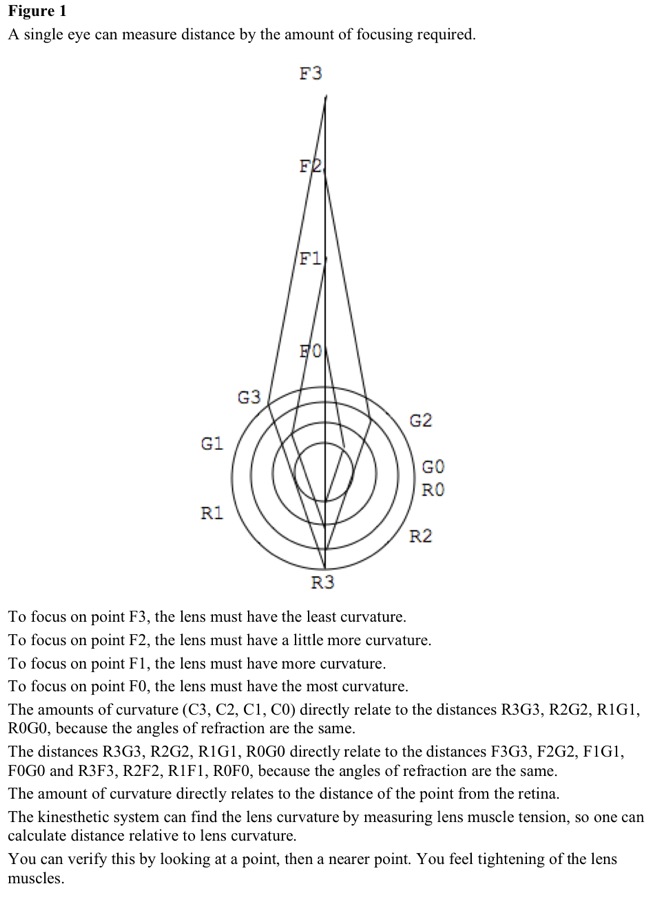
Far objects require no eye focusing. Objects within four feet require eye focusing to reduce blur. Brain can judge distance by muscle tension, so one eye can measure distance. See Figure 1.
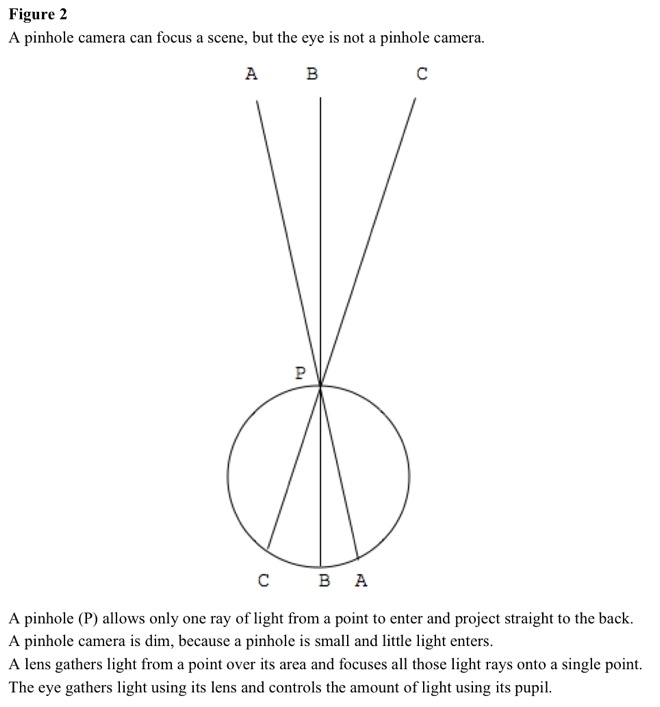
Pinhole camera can focus scene, but eye is not pinhole camera. See Figure 2.
far focus
If accommodation is for point beyond object, magnification is too low, edges are blurry, and spatial-frequency response is lower, because scene-point light rays land on different retina locations, before they meet at focal point. Focal point is past retina.
near focus
If accommodation is for point nearer than object, magnification is too high, edges are blurry, and spatial-frequency response is lower, because scene-point light rays meet at focal point and then land on different retina locations. Focal point is in eye middle.
Consciousness>Consciousness>Sense>Vision>Physiology>Focusing
1-Consciousness-Sense-Vision-Physiology-Focusing
Outline of Knowledge Database Home Page
Description of Outline of Knowledge Database
Date Modified: 2022.0224